Jobs
What they are trying to do
Let teams use AI, pass audits, find the right information, and keep work moving.
Company
What we give a security, compliance or IT buyer, matched to what that buyer needs.
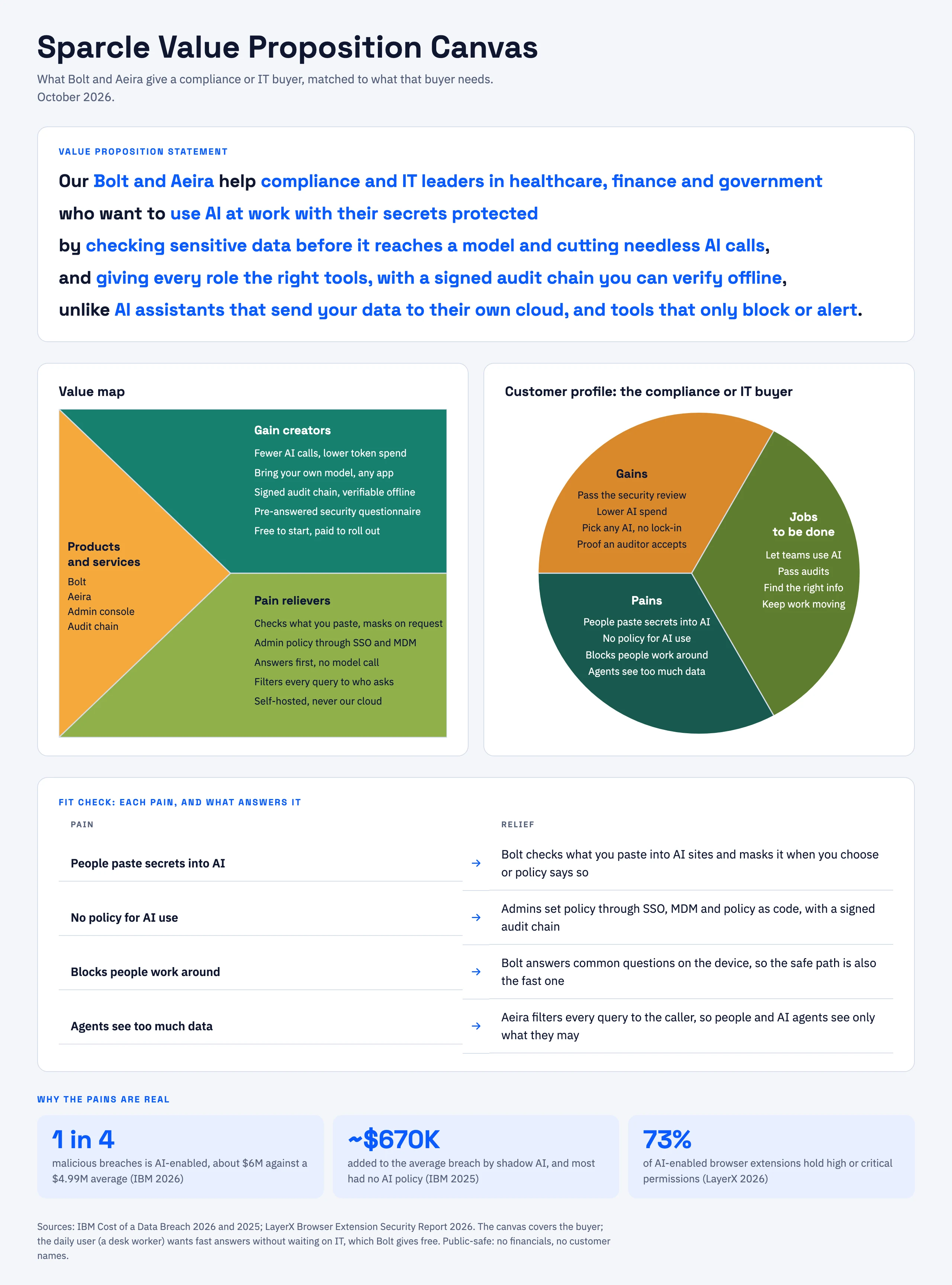
Fit check
| The pain | What answers it |
|---|---|
| People paste secrets into AI | Bolt checks what you paste into AI sites on your device, and masks it when you choose or policy says so. |
| No policy for AI use | Admins set policy through SSO, MDM and policy as code, with a signed audit chain you can verify offline. |
| Blocks people work around | Bolt answers common questions on the device with no model call, so the safe path is also the fast one. |
| Agents see too much data | Aeira filters every query to the caller, so people and AI agents see only what they are entitled to see. |
The buyer
Jobs
Let teams use AI, pass audits, find the right information, and keep work moving.
Gains
Pass the security review, lower AI spend, pick any AI with no lock-in, and have proof an auditor accepts.
Pains
People paste secrets into AI, there is no policy for AI use, blocks get worked around, and agents see too much data.
Why the pains are real
The same third-party figures we cite elsewhere on the site, with their editions.
malicious breaches is AI-enabled, at about $6M against a $4.99M average. IBM Cost of a Data Breach, 2026.
added to the average breach by shadow AI, and most breached organizations had no AI governance policy. IBM Cost of a Data Breach, 2025.
of AI-enabled browser extensions hold high or critical permission scope. LayerX Browser Extension Security Report, 2026.
Next
The business model page lays out who we serve and what every tier costs.